conductor
A natural-language interface to the L-functions and Modular Forms Database (LMFDB).
Website: conductormath.org. GitHub: https://github.com/rjain2470/conductor.
The L-functions and Modular Forms Database (LMFDB) is a comprehensive dataset of mathematical objects arising in number theory and arithmetic geometry, cataloguing hundreds of thousands of elliptic curves, modular forms, number fields, and more. With the increasing usage of machine learning methods in mathematics, it has become an important source for exploratory data analysis and mathematical discovery, with one notable example being the discovery of the murmurations phenomenon.
While the LMFDB has a web interface, querying and analyzing data often requires going through its underlying SQL server, which is often difficult even for technical users. To solve this problem, we introduce Conductor, a natural language interface to the LMFDB. It translates mathematical questions into SQL, executes them against the LMFDB PostgreSQL database, and returns structured data with optional exploratory analysis and plots. It is designed to make the rich collection of mathematical data in the LMFDB more accessible for exploration, research, and teaching.
Given a query in plain English, Conductor identifies and retrieves the relevant mathematical data from the database, and can optionally summarize, analyze, or visualize the results at the user’s convenience. This allows users to explore the LMFDB without needing to learn its internal structure or write database queries by hand.
For instance, a mathematician can directly ask Conductor the following questions:
"Plot the regulator against the conductor for the rank-1 elliptic curves over Q with conductor under 10,000 on a log-log scale."
"What is the average rank of the elliptic curves with conductor less than 5000?"
"Give me a table of the weight-2 newforms with CM at squarefree levels under 500."
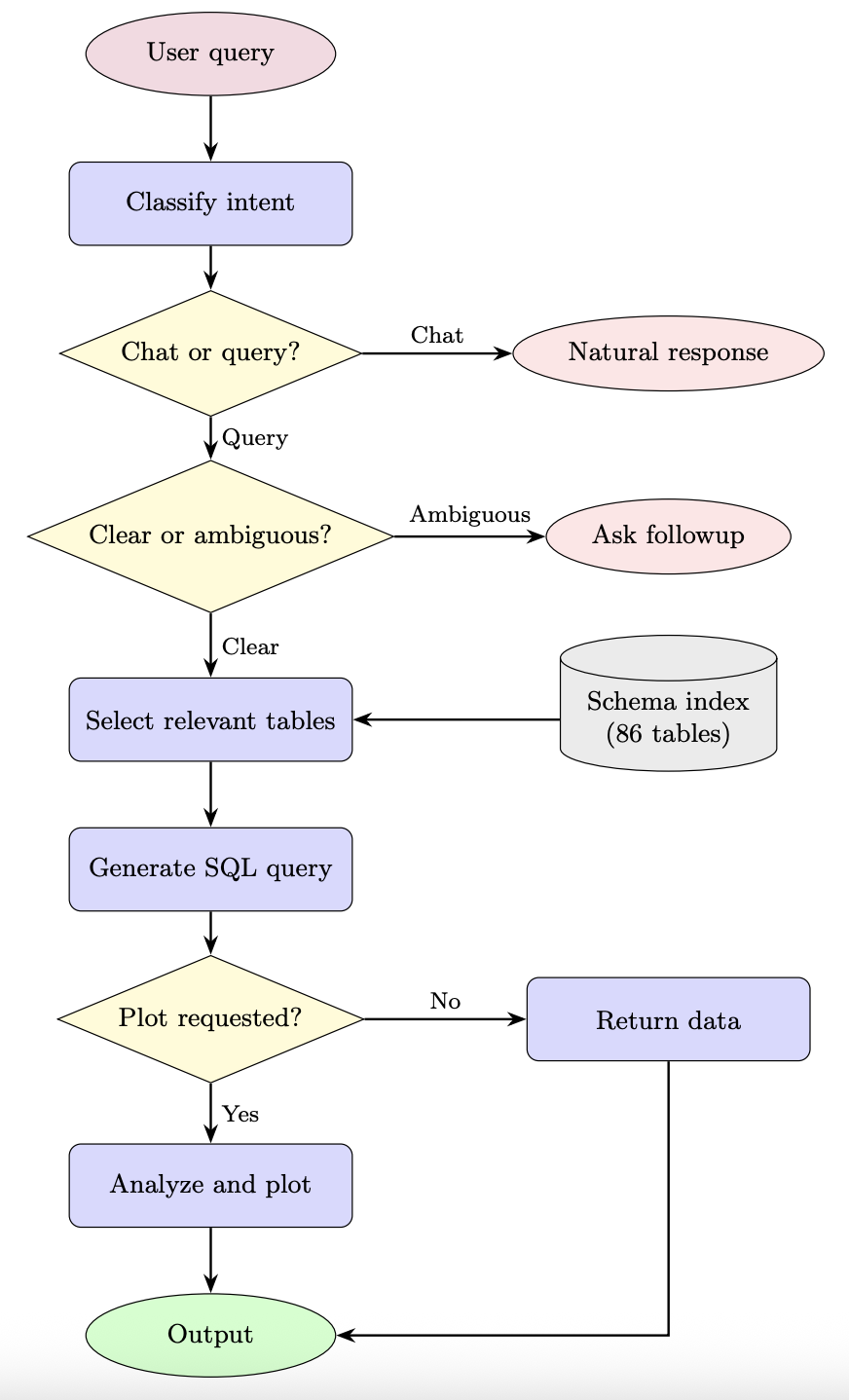
Under the hood, Conductor operates via a multi-stage pipeline. First, queries are classified and scanned for keywords. Then, a separate LLM later routes to the relevant parts of the SQL schema, pulls the relevant data, then optiomally passes the results to a data analysis stage. Finally, the output is returned to the user together with all of the generated code. In sum, Conductor is an attempt to reduce friction for mathematicians using the LMFDB and accelerate progress in data-driven mathematical research, while ensuring a maximal amount of transparency.
Limitations
Conductor connects to devmirror.lmfdb.xyz, which may only have partial coverage of the full LMFDB. Moreover, since the LMFDB itself is not fully comprehensive, some data may simply be unavailable. Responses may also slow under heavy load, as queries are subject to API rate limits. Finally, Conductor is under active development, and you may encounter occasional errors or unexpected behavior. If you do, please open a GitHub issue.
Future Work
As of now, Conductor operates via a layered pipeline of LLM calls which handle various tasks, including user interactions, SQL generation, data analysis, and more. While this pipeline is functional and works well, its reasoning capabilities are limited by the fact that each stage is executed independently with a small context window.
A more robust and modern architecture would replace the current layered approach with a single agentic LLM equipped with tools designed for it to execute each aspect of the pipeline. Here, rather than passing through a fixed pipeline with a different LLM at each stage, the model would plan its own approach, iterating and correcting errors until it has an optimal final response.
A natural next step is to integrate this pipeline with an agentic framework via a Model Context Protocol (MCP) server. Building on the recent LMFDB MCP developed by Andrew Sutherland, this server would add a semantic layer, allowing users to ask and receive responses in plain English, and would also add a richer contextual toolset for the backend. As agentic systems grow increasingly capable, we believe that such substrates will provide exciting opportunities for mathematical discovery.